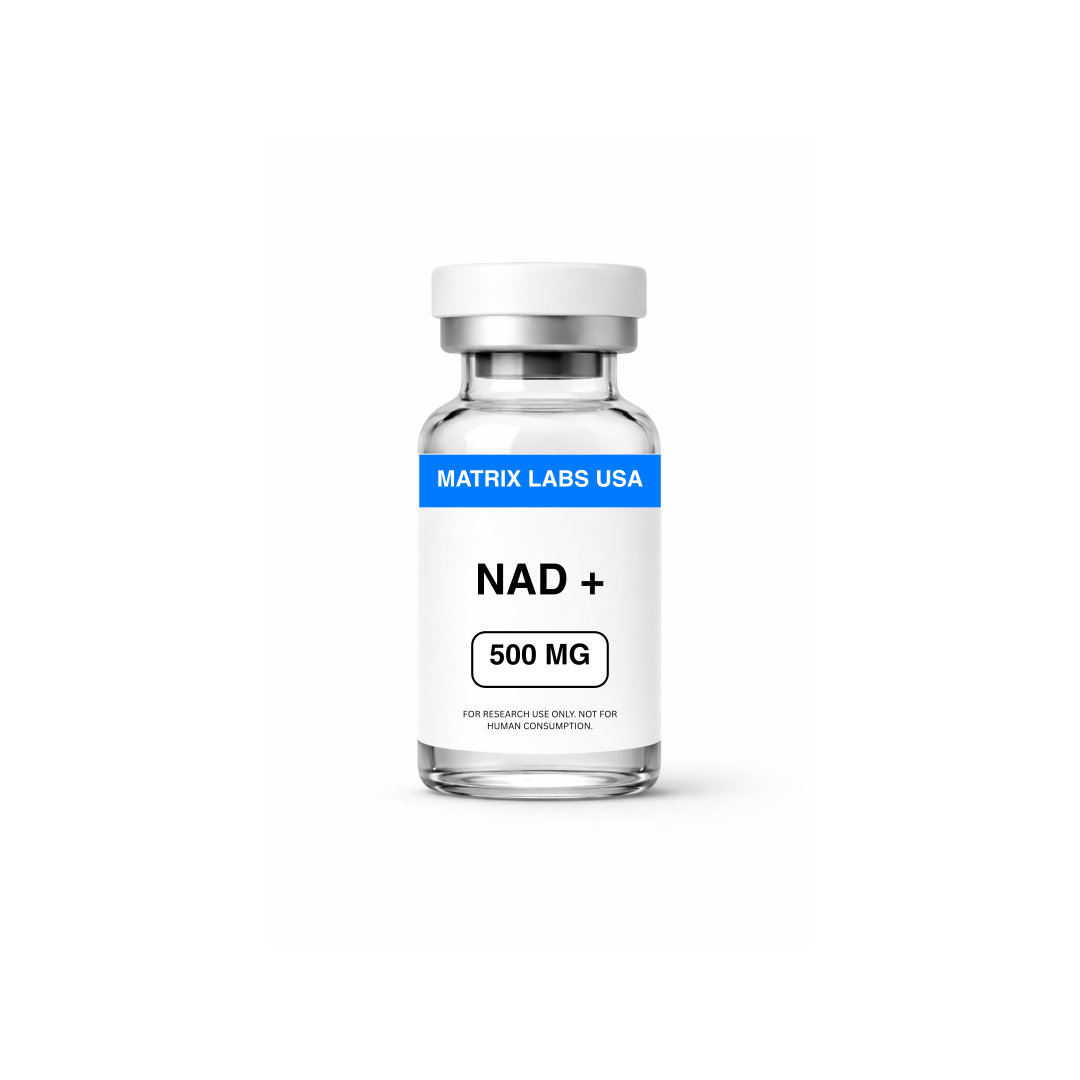
NAD+
$125.00
Contents: 500mg NAD+ lyophilized in sterile glass vial
Purity: ≥99% (HPLC verified by independent third-party laboratory)
Grade: Research-use only (not a drug, food, or supplement)
Form: Lyophilized powder, suitable for reconstitution with appropriate solvent
Storage (before reconstitution): Store at room temperature, protected from heat and light
Storage (after reconstitution): Store refrigerated at 2–8°C/ 35–45°F and use promptly according to your lab protocol
Note: This product is supplied as a lyophilized powder and should be reconstituted with bacteriostatic water for appropriate research handling.
Most researchers also add BAC Water 3ML to their order for convenience.
For laboratory research only. Not for human consumption, medical, or veterinary use.
Nicotinamide adenine dinucleotide (NAD⁺) is a ubiquitous pyridine nucleotide coenzyme used in laboratory systems to study cellular redox balance, bioenergetics, and metabolic network behavior. In experimental settings, NAD⁺ is commonly evaluated through its reversible cycling with NADH, providing a measurable handle on electron-transfer reactions that support glycolytic and mitochondrial readouts.
Beyond classical redox chemistry, NAD⁺ is also treated as an enzymatic substrate for multiple NAD⁺-consuming enzyme families (including sirtuins and PARPs) that connect nucleotide availability to signaling, DNA-damage response measurements, and transcription-linked datasets in non-clinical models.
Note: This product is supplied as a lyophilized powder and should be reconstituted with bacteriostatic water for appropriate research handling.
Most researchers also add BAC Water 3ML to their order for convenience.
For laboratory research only. Not for human consumption, medical, or veterinary use.
Molecular formula: C21H27N7O14P2
Molecular weight: 663.43 g/mol
CAS number: 53-84-9
PubChem: CID 925
In research workflows, NAD⁺ is frequently handled as a redox-active cofactor for dehydrogenase-coupled assays and as a limiting reagent or tracked pool for NAD⁺-dependent enzyme activity measurements.
NAD⁺ is routinely incorporated into redox biochemistry assays to quantify or couple oxidation–reduction reactions (for example, dehydrogenase-driven readouts that report on NAD⁺/NADH turnover).
NAD⁺ is also used in NAD⁺-dependent enzyme systems where consumption of NAD⁺ (or formation of reaction products) is measured as a proxy for activity in sirtuin, PARP, and related signaling-linked enzyme assays.
In cellular and animal-model research, NAD⁺ status is often profiled alongside transcriptomic, proteomic, and metabolomic outputs to contextualize pathway shifts tied to mitochondrial function, stress-response programs, and aging-associated datasets.
NAD⁺ sits at the intersection of bioenergetic flux and signaling-linked NAD⁺ consumption, so research discussions commonly frame it as both an electron carrier for metabolic reactions and a substrate pool competed over by multiple enzyme families.
Within aging and stress-oriented literature, reported declines in NAD⁺ levels (across multiple model systems) are often interpreted alongside measures of DNA-damage signaling, chromatin regulation, and immune or inflammatory readouts, with emphasis on mechanistic links rather than clinical claims.
Because NAD⁺ pools are compartmentalized and dynamically replenished, it is also frequently discussed in the context of biosynthetic routes and turnover pathways that shape measurable NAD⁺ availability in different subcellular locations.
Mitochondrial and metabolic model systems frequently report relationships between NAD⁺ availability and measured oxidative phosphorylation or redox-state endpoints, treating NAD⁺ as a quantitative variable that shifts alongside metabolic program changes.
In aging-oriented datasets, published work commonly links altered NAD⁺ levels to downstream signatures in gene expression, DNA repair–associated pathways, and NAD⁺-consuming enzyme activity, describing associations observed under controlled experimental conditions.
Rodent studies have also evaluated exogenous NAD⁺ exposure using non-clinical paradigms, reporting changes in measured tissue NAD⁺ metrics and injury-associated endpoints in models of acute neurologic insult; these findings are presented within preclinical frameworks and do not establish clinical utility.
Covarrubias AJ, Perrone R, Grozio A, Verdin E. NAD⁺ metabolism and its roles in cellular processes during ageing. Nature Reviews Molecular Cell Biology. 2021;22(2):119–141. doi:10.1038/s41580-020-00313-x.
Cantó C, Menzies KJ, Auwerx J. NAD⁺ metabolism and the control of energy homeostasis: a balancing act between mitochondria and the nucleus. Cell Metabolism. 2015;22(1):31–53. doi:10.1016/j.cmet.2015.05.023.
Ying W, Wei G, Wang D, Wang Q, Tang X, Shi J, Zhang P, Lu H. Intranasal administration with NAD⁺ profoundly decreases brain injury in a rat model of transient focal ischemia. Frontiers in Bioscience. 2007;12:2728–2734. doi:10.2741/2267.
Verdin E. NAD⁺ in aging, metabolism, and neurodegeneration. Science. 2015;350(6265):1208–1213. doi:10.1126/science.aac4854.
Imai S, Guarente L. NAD⁺ and sirtuins in aging and disease. Trends in Cell Biology. 2014;24(8):464–471.
Nikiforov A, Dölle C, Niere M, Ziegler M. The human NAD metabolome: functions, metabolism and compartmentalization. Critical Reviews in Biochemistry and Molecular Biology. 2015.
Won SJ, et al. Prevention of traumatic brain injury-induced neuron death by intranasal delivery of nicotinamide adenine dinucleotide. Journal of Neurotrauma. (Full text in PMC).
beta-Nicotinamide adenine dinucleotide (NAD⁺) chemical record. PubChem.
To protect experimental integrity, store peptides cold, dry, and shielded from light to minimize oxidation, contamination, and degradation. For near-term use, keep unopened material refrigerated at ≤4 °C (≤39 °F) and limit time at room temperature during handling. Lyophilized (dry) peptides can tolerate short periods at room temperature, but refrigeration is preferred for best stability and longevity. For longer-term storage, keep unmixed material frozen—−18 °C (0 °F) is acceptable, while −80 °C (−112 °F) is optimal for multi-month to multi-year preservation. Avoid frost-free freezers and repeated freeze–thaw cycles, which can accelerate breakdown. If reconstituted (in solution), use sterile buffer (ideally pH 5–6 when feasible), split into aliquots, and freeze (preferably −80 °C (−112 °F)) to reduce handling-related degradation.
All Articles and product information provided on this website are for informational and educational purposes only.
Popular products
-

MT II
$50.00 Select options This product has multiple variants. The options may be chosen on the product page -
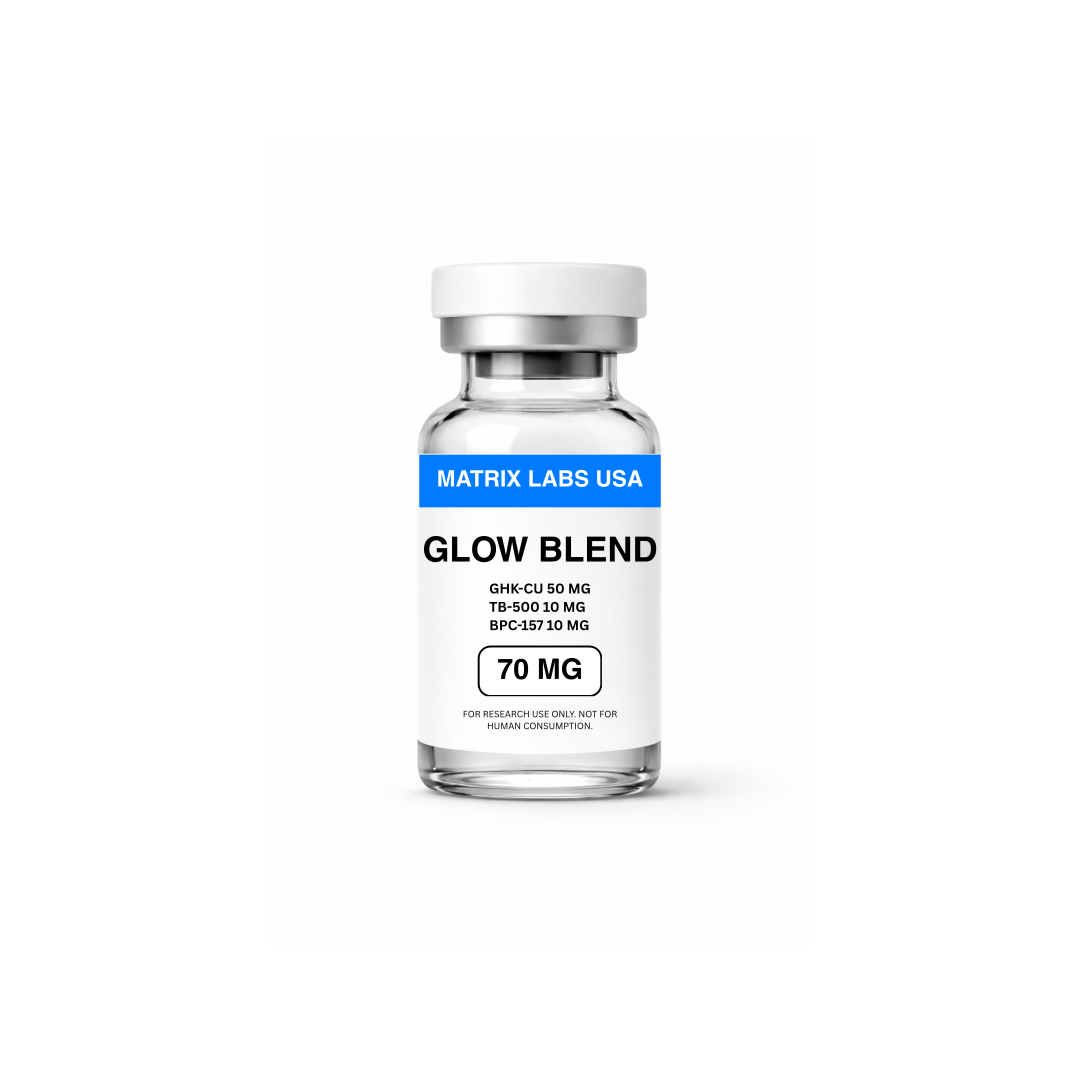
GLOW Blend
$140.00 Select options This product has multiple variants. The options may be chosen on the product page -
CJC + Ipamorelin
$70.00 Select options This product has multiple variants. The options may be chosen on the product page -
Ipamorelin
$55.00 Select options This product has multiple variants. The options may be chosen on the product page
Reviews
There are no reviews yet.