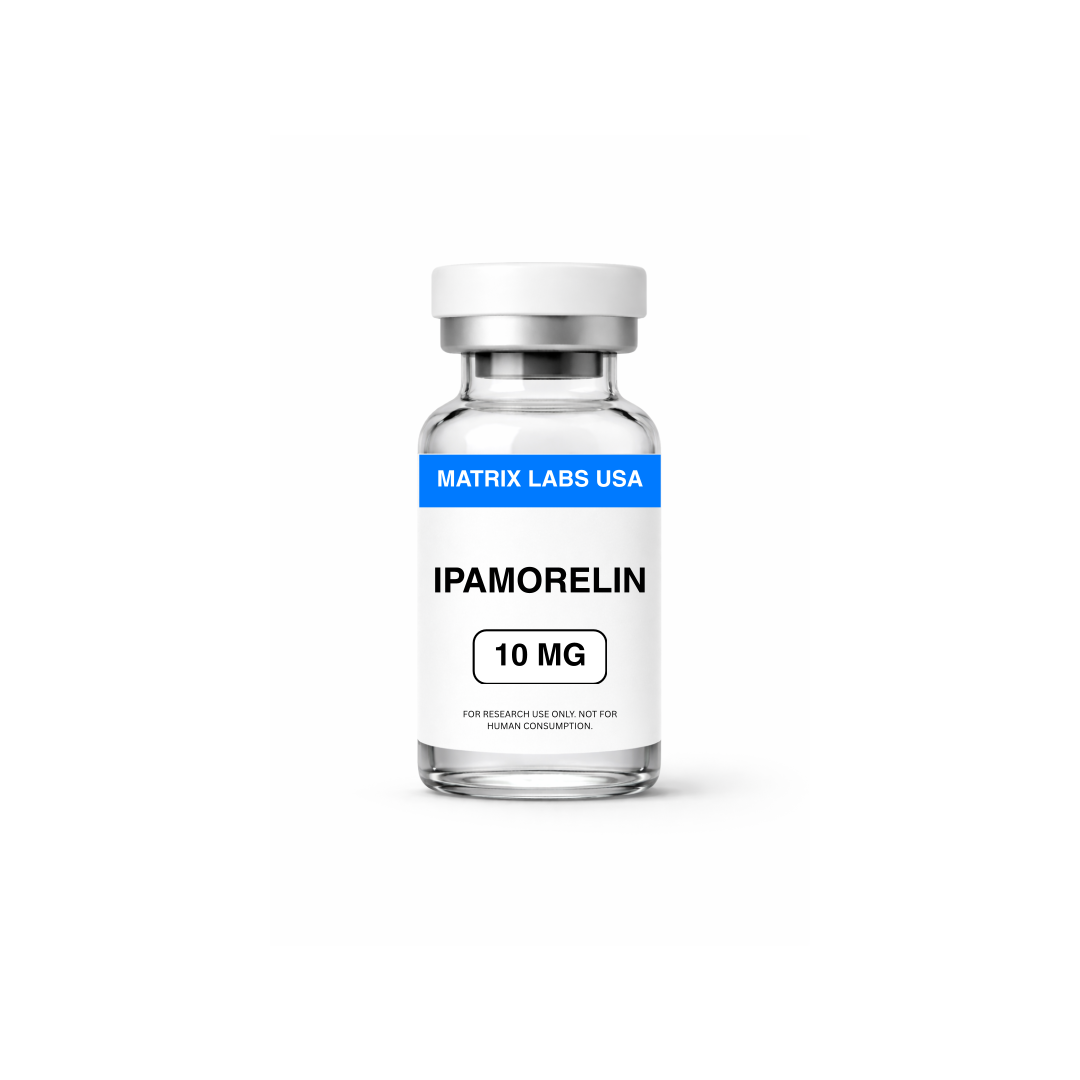

Ipamorelin
$55.00
Contents: 10mg Ipamorelin lyophilized peptide in sterile glass vial
Purity: ≥99% (HPLC verified by independent third-party laboratory)
Grade: Research-use only (not a drug, food, or supplement)
Form: Lyophilized powder, suitable for reconstitution with appropriate solvent
Storage (before reconstitution): Store at room temperature, protected from heat and light
Storage (after reconstitution): Store refrigerated at 2–8°C and use promptly according to your lab protocol
Note: This product is supplied as a lyophilized powder and should be reconstituted with bacteriostatic water for appropriate research handling.
Most researchers also add BAC Water 3ML to their order for convenience.
For laboratory research only. Not for human consumption, medical, cosmetic, or veterinary use.
Ipamorelin is a synthetic pentapeptide widely used in laboratory research as a comparatively selective ligand for the growth hormone secretagogue receptor (GHSR 1a), also referred to as the ghrelin receptor. In controlled experimental systems, it is commonly employed as a pharmacologic probe to examine receptor binding behavior, ligand selectivity, and downstream GPCR signaling events associated with GHSR activation.
Note: This product is supplied as a lyophilized powder and should be reconstituted with bacteriostatic water for appropriate research handling.
Most researchers also add BAC Water 3ML to their order for convenience.
For laboratory research only. Not for human consumption, medical, cosmetic, or veterinary use.
Peptide sequence: Aib-His-D-2Nal-D-Phe-Lys Molecular formula: C38H49N9O5
Molecular weight: 711.868 g/mol
PubChem CID: 9831659
CAS number: 170851 70 4Non proteinogenic residues in the sequence are often leveraged in study design when evaluating receptor selectivity and stability related parameters in model systems. Ipamorelin is typically prepared by solid phase peptide synthesis and characterized using standard analytical workflows such as chromatography and mass spectrometry.
Ipamorelin is intended for non clinical research use and is commonly applied in preclinical or in vitro workflows such as:
GHSR 1a binding affinity and selectivity assaysSecond messenger signaling studies, including cAMP linked readouts and calcium mobilization assays
Structure activity and comparator studies versus other ghrelin mimetics or secretagogue class ligands
Endocrine axis modeling in animal systems as a receptor selective tool compound
Mechanistic studies exploring GI motility signaling, pancreatic islet signaling, and related metabolic endpoints in defined experimental settings
GHSR 1a is a GPCR originally characterized as the target for growth hormone secretagogues, with signaling that can involve calcium dependent pathways and modulation of adenylate cyclase activity depending on the cellular context. For mechanistic experiments, ipamorelin is often used to help isolate GHSR mediated signaling from broader, less selective secretagogue activity, enabling clearer interpretation of receptor coupled second messenger dynamics and downstream phosphorylation or transcriptional responses.
Because the ghrelin receptor is also known to exhibit constitutive activity in some expression systems, study designs commonly include appropriate controls (vehicle, inverse agonist or antagonist comparators, and time matched baselines) when mapping ligand driven signaling contributions.
Receptor pharmacology and translational modeling
Human volunteer data have been used to characterize ipamorelin exposure response relationships and the time course of growth hormone stimulation under controlled conditions, supporting PK/PD modeling approaches for secretagogue class ligands.
Gastrointestinal motility and postoperative ileus models
Rodent postoperative ileus models have evaluated ipamorelin as a ghrelin mimetic in experimental paradigms tracking transit and recovery related endpoints, including colonic transit timing and related functional measures.
Pancreatic islet and insulin secretion signaling
Isolated pancreatic tissue and diabetic rodent models have investigated ipamorelin associated insulin secretion mechanisms, including pharmacologic blockade experiments to probe pathway involvement in insulin release.
Gobburu JV, Agersø H, Jusko WJ, Ynddal L. Pharmacokinetic pharmacodynamic modeling of ipamorelin, a growth hormone releasing peptide, in human volunteers. Pharmaceutical Research. 1999;16(9):1412–1416. doi:10.1023/a:1018955126402
Venkova K, Mann W, Nelson R, Greenwood Van Meerveld B. Efficacy of ipamorelin, a novel ghrelin mimetic, in a rodent model of postoperative ileus. Journal of Pharmacology and Experimental Therapeutics. 2009;329(3):1110–1116. doi:10.1124/jpet.108.149211
Holst B, Cygankiewicz A, Jensen TH, Ankersen M, Schwartz TW. High constitutive signaling of the ghrelin receptor: Identification of a potent inverse agonist. Molecular Endocrinology. 2003;17(11):2201–2210. doi:10.1210/me.2003-0069
Howard AD, Feighner SD, Cully DF, et al. A receptor in pituitary and hypothalamus that functions in growth hormone release. Science. 1996;273(5277):974–977. doi:10.1126/science.273.5277.974
Adeghate E, Ponery AS. Mechanism of ipamorelin evoked insulin release from the pancreas of normal and diabetic rats. Neuro Endocrinology Letters. 2004;25(6):403–406.
Yin Y, Li Y, Zhang W. The growth hormone secretagogue receptor: Its intracellular signaling and regulation. International Journal of Molecular Sciences. 2014. (Open access via PMC)
To protect experimental integrity, store peptides cold, dry, and shielded from light to minimize oxidation, contamination, and degradation. For near-term use, keep unopened material refrigerated at ≤4 °C (≤39 °F) and limit time at room temperature during handling. Lyophilized (dry) peptides can tolerate short periods at room temperature, but refrigeration is preferred for best stability and longevity. For longer-term storage, keep unmixed material frozen—−18 °C (0 °F) is acceptable, while −80 °C (−112 °F) is optimal for multi-month to multi-year preservation. Avoid frost-free freezers and repeated freeze–thaw cycles, which can accelerate breakdown. If reconstituted (in solution), use sterile buffer (ideally pH 5–6 when feasible), split into aliquots, and freeze (preferably −80 °C (−112 °F)) to reduce handling-related degradation.
All Articles and product information provided on this website are for informational and educational purposes only.
Popular products
-

Wolverine
$100.00 Select options This product has multiple variants. The options may be chosen on the product page -
MT II
$50.00 Select options This product has multiple variants. The options may be chosen on the product page -
KPV
Price range: $40.00 through $65.00 Select options This product has multiple variants. The options may be chosen on the product page -
Semax
$50.00 Select options This product has multiple variants. The options may be chosen on the product page
Reviews
There are no reviews yet.