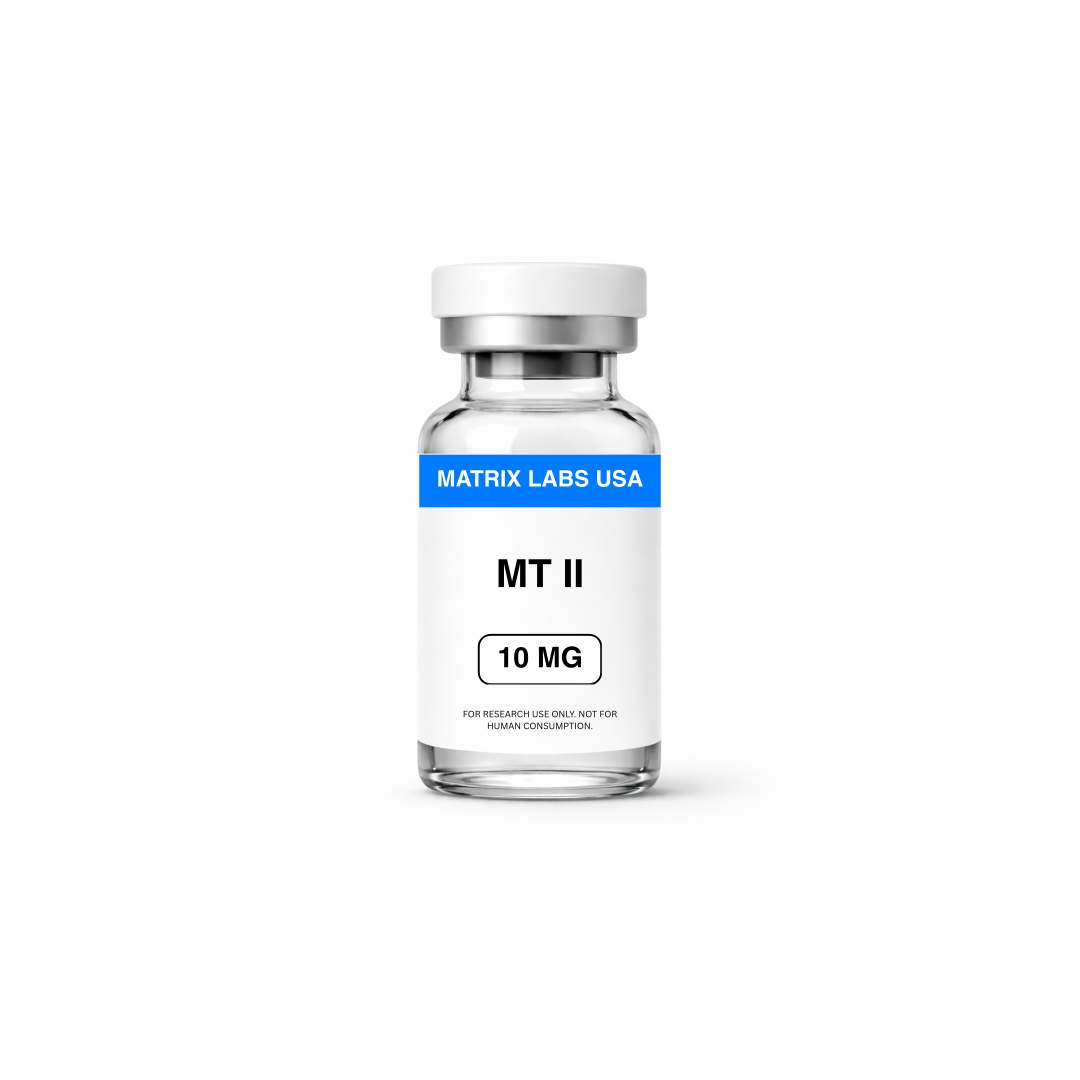
MT II
$50.00
Contents: 10mg MT2 (Melanotan II) lyophilized peptide in sterile glass vial
Purity: ≥99% (HPLC verified by independent third-party laboratory)
Grade: Research-use only (not a drug, food, or supplement)
Form: Lyophilized powder, suitable for reconstitution with appropriate solvent
Storage (before reconstitution): Store at room temperature, protected from heat and light
Storage (after reconstitution): Store refrigerated at 2–8°C and use promptly according to your lab protocol
Note: This product is supplied as a lyophilized powder and should be reconstituted with bacteriostatic water for appropriate research handling.
Most researchers also add BAC Water 3ML to their order for convenience.
For laboratory research only. Not for human consumption, medical, or veterinary use.
Melanotan 2 (MT-II) is a synthetic, cyclic melanocortin peptide commonly used in laboratory research as a defined-sequence agonist input for melanocortin receptor pharmacology and downstream signaling assays.
In controlled experimental systems, MT-II is frequently applied to probe melanocortin-driven pathways relevant to pigmentation biology and CNS-linked neuroendocrine signaling, with study designs typically focusing on receptor potency/efficacy, second-messenger outputs, and time-course pathway behavior.
Note: This product is supplied as a lyophilized powder and should be reconstituted with bacteriostatic water for appropriate research handling.
Most researchers also add BAC Water 3ML to their order for convenience.
For laboratory research only. Not for human consumption, medical, or veterinary use.
Peptide sequence: Nle-Asp(1)-His-D-Phe-Arg-Trp-Lys(1)
Common structural notation: Ac-Nle-c[Asp-His-D-Phe-Arg-Trp-Lys]-NH₂
Molecular formula: C50H69N15O9
Molecular weight: 1024.198 g/mol
PubChem CID: 92432
CAS number: 121062-08-6
MT-II is often used in receptor pharmacology workflows to compare functional responses across melanocortin receptor subtypes and to support structure–activity relationship studies based on the MT-II scaffold.
In signal-transduction experiments, MT-II is commonly used to elicit melanocortin GPCR outputs such as cAMP-linked responses and downstream kinase pathway readouts under controlled conditions.
In preclinical neuroscience paradigms, MT-II may be applied as a tool agonist to investigate melanocortin-linked circuitry in models evaluating feeding behavior, motivation/reward-relevant endpoints, and related neurobehavioral measures.
In pigmentation-focused research, MT-II is frequently discussed as an experimental input for melanocyte-associated signaling and transcriptional programs downstream of melanocortin receptor activation.
MT-II is broadly characterized as a potent, nonselective melanocortin receptor agonist, with activity reported across multiple melanocortin receptor subtypes (commonly framed as MC1R, MC3R, MC4R, and MC5R).
Melanocortin receptors are GPCRs classically linked to cAMP signaling, and MT-II is frequently used to stimulate these pathways in cell-based systems where receptor expression, desensitization, and signaling kinetics can be measured directly.
Human pilot studies have evaluated MT-II as a melanotropic probe, reporting quantifiable pigmentation changes after a short dosing sequence in a small Phase I setting, alongside tolerability observations and physiologic effects consistent with central melanocortin engagement.
In animal research, centrally administered MT-II has been used as an experimental tool to interrogate melanocortin-3/4–linked physiology, including studies designed to separate direct central effects from secondary changes driven by food intake.
The MT-II scaffold has also been extensively used in medicinal chemistry and receptor-mapping work, where systematic substitutions and conformational analysis help identify residue contributions that govern receptor binding and functional activity.
Dorr, R. T., Lines, R., Levine, N., Brooks, C., Xiang, L., Hruby, V. J., & Hadley, M. E. (1996). Evaluation of melanotan-II, a superpotent cyclic melanotropic peptide in a pilot phase-I clinical study. Life Sciences.
Bednarek, M. A., MacNeil, T., Kalyani, R. N., Tang, R., Van der Ploeg, L. H. T., & Weinberg, D. H. (1999). Structure-function studies on the cyclic peptide MT-II, lactam derivative of alpha-melanotropin. Journal of Medicinal Chemistry.
Ericson, M. D., Wilczynski, A., & others. (2017). Bench-Top to Clinical Therapies: A Review of Melanocortin Ligands from 1954 to 2016. Biochimica et Biophysica Acta (BBA) – Molecular Basis of Disease.
Heijboer, A. C., van den Hoek, A. M., Pijl, H., Voshol, P. J., Havekes, L. M., Romijn, J. A., & Corssmit, E. P. M. (2005). Intracerebroventricular administration of melanotan II increases insulin sensitivity of glucose disposal in mice. Diabetologia, 48(8), 1621–1626. https://doi.org/10.1007/s00125-005-1838-8
Cai, M., & Hruby, V. J. (2016). The Melanocortin Receptor System: A Target for Multiple Degenerative Diseases. Current Protein & Peptide Science.
Olney, J. J., Navarro, M., Thiele, T. E., & others. (2013). The protective effects of the melanocortin receptor (MCR) agonist melanotan-II (MTII) on voluntary ethanol consumption in mice. Alcoholism: Clinical and Experimental Research.
PubChem. melanotan-II (CID 92432). National Library of Medicine compound record.
To protect experimental integrity, store peptides cold, dry, and shielded from light to minimize oxidation, contamination, and degradation. For near-term use, keep unopened material refrigerated at ≤4 °C (≤39 °F) and limit time at room temperature during handling. Lyophilized (dry) peptides can tolerate short periods at room temperature, but refrigeration is preferred for best stability and longevity. For longer-term storage, keep unmixed material frozen—−18 °C (0 °F) is acceptable, while −80 °C (−112 °F) is optimal for multi-month to multi-year preservation. Avoid frost-free freezers and repeated freeze–thaw cycles, which can accelerate breakdown. If reconstituted (in solution), use sterile buffer (ideally pH 5–6 when feasible), split into aliquots, and freeze (preferably −80 °C (−112 °F)) to reduce handling-related degradation.
All Articles and product information provided on this website are for informational and educational purposes only.
Popular products
-

KPV
Price range: $40.00 through $65.00 Select options This product has multiple variants. The options may be chosen on the product page -
DSIP
$60.00 Select options This product has multiple variants. The options may be chosen on the product page -
Tesamorelin
$60.00 Select options This product has multiple variants. The options may be chosen on the product page -
BPC-157
Original price was: $70.00.$65.00Current price is: $65.00. Select options This product has multiple variants. The options may be chosen on the product page
Reviews
There are no reviews yet.