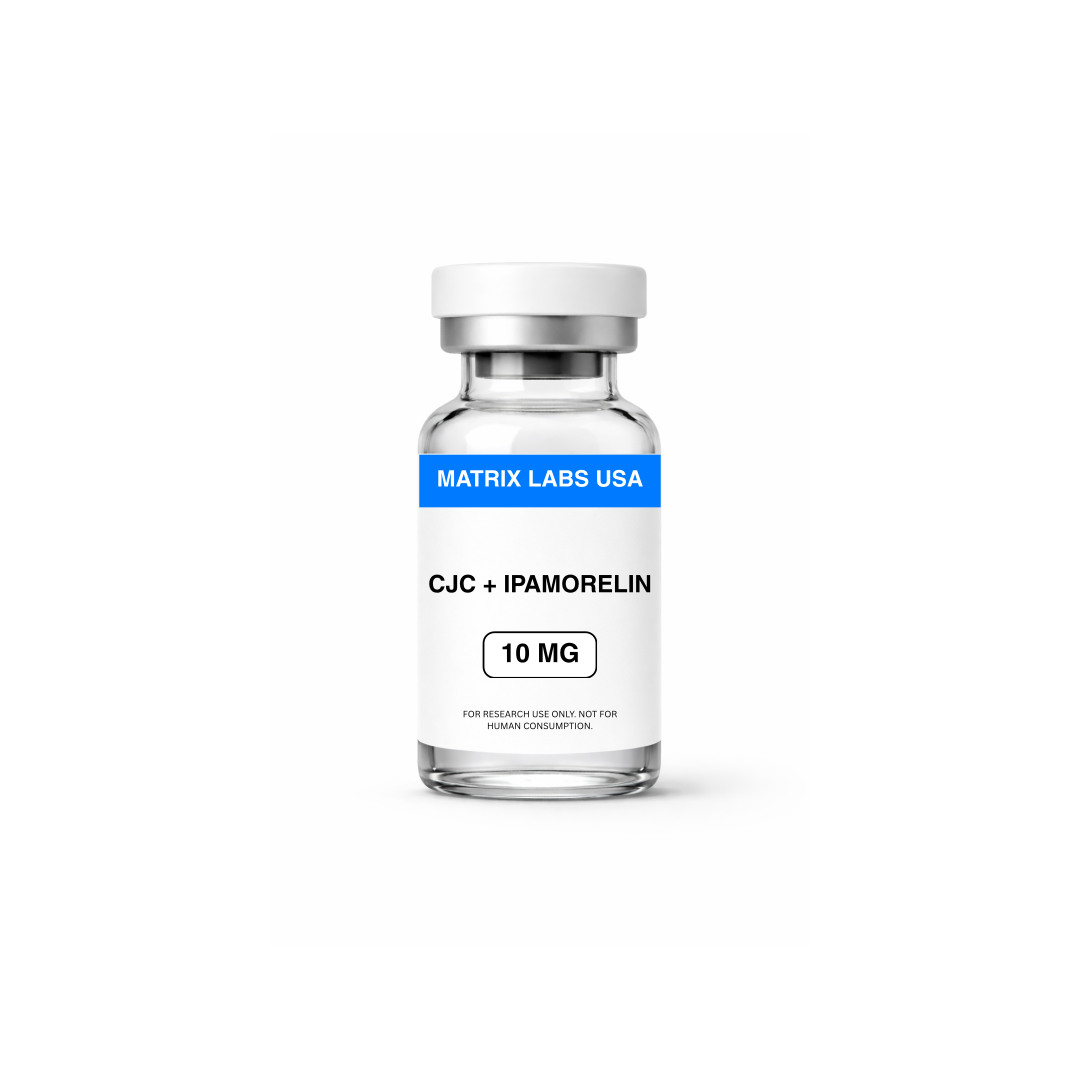
CJC + Ipamorelin
$70.00
Contents: 10mg total peptide blend per vial
Composition: 5mg CJC-1295 + 5mg Ipamorelin (lyophilized blend) in sterile glass vial
Purity: ≥99% combined peptide content (HPLC verified by independent third-party laboratory)
Grade: Research-use only (not a drug, food, or supplement)
Form: Lyophilized peptide blend, suitable for reconstitution with appropriate solvent
Storage (before reconstitution): Store at room temperature, protected from heat and light
Storage (after reconstitution): Store refrigerated at 2–8°C and use promptly according to your lab protocol
Note: This product is supplied as a lyophilized powder and should be reconstituted with bacteriostatic water for appropriate research handling.
Most researchers also add BAC Water 3ML to their order for convenience.
For laboratory research only. Not for human consumption, medical, cosmetic, or veterinary use.
CJC-1295 (No DAC; Mod GRF 1–29) / Ipamorelin is a blended research peptide formulation designed for laboratory investigations of growth hormone–axis signaling. In experimental systems, CJC-1295 (No DAC) functions as a growth hormone–releasing hormone (GHRH) analog that targets the GHRH receptor (GHRHR), while Ipamorelin acts as a selective ghrelin receptor (GHSR-1a) agonist. Used together, the blend supports studies of coordinated receptor activation and downstream pathways involved in pulsatile endocrine signaling, including cAMP/PKA- and calcium-dependent signaling cascades and their effects on growth hormone release dynamics and related IGF-axis readouts.
Note: This product is supplied as a lyophilized powder and should be reconstituted with bacteriostatic water for appropriate research handling.
Most researchers also add BAC Water 3ML to their order for convenience.
For laboratory research only. Not for human consumption, medical, cosmetic, or veterinary use.
CJC-1295 (No DAC; Mod GRF 1–29) is a synthetic analog of endogenous GHRH built on the N-terminal 29–amino-acid segment. It’s engineered to better resist proteolytic breakdown while maintaining strong binding/functional activity at the GHRH receptor (GHRHR).
Ipamorelin is a synthetic pentapeptide that serves as a highly selective agonist of the ghrelin / growth hormone secretagogue receptor (GHSR-1a). In research settings, it is commonly used to probe receptor-specific signaling with comparatively limited off-target pituitary hormone activation.
This blend can be used as a research tool to support studies such as:
Coordinated dual-receptor signaling (GHRHR and GHSR-1a)
Pulsatile endocrine dynamics and receptor cross-talk
Second-messenger pathway interrogation (cAMP-linked and Ca²⁺-linked signaling)
Downstream readouts related to IGF-axis modulation in preclinical models
In controlled experimental systems, the components are positioned as mechanistically distinct secretagogues: CJC-1295 (No DAC) engages GHRHR and is associated with cAMP/PKA signaling linked to GH synthesis, while Ipamorelin engages GHSR-1a and is associated with Gq/11-coupled Ca²⁺ signaling. Together, they can serve as a model for investigating GH pulsatility, receptor cross-talk, and hypothalamic–pituitary regulation.
In preclinical contexts, CJC-1295 (No DAC; Mod GRF 1–29) and Ipamorelin are commonly treated as complementary tools for interrogating growth hormone (GH)–axis regulation under controlled experimental conditions. CJC-1295 (No DAC) is used to model GHRH receptor (GHRHR) activation and associated Gs/cAMP/PKA signaling, supporting evaluation of pituitary somatotroph responsiveness and GH secretory dynamics. Ipamorelin is used as a comparatively selective GHSR-1a agonist to examine PLC/IP₃-dependent calcium mobilization, receptor desensitization, and downstream transcriptional or secretory readouts linked to secretagogue signaling.
When applied together in vitro or in animal models, the blend can support studies of receptor cross-talk, signaling convergence/divergence, and pulsatile endocrine behavior, including how secretagogue input patterns influence GH output and downstream markers relevant to the IGF axis. Readouts in preclinical studies may include time-resolved GH measurements, second-messenger assays (cAMP and Ca²⁺), pituitary gene expression endpoints, and pathway-specific phosphorylation or reporter assays to map mechanism-of-action hypotheses.
Howard, A. D., Feighner, S. D., Cully, D. F., Arena, J. P., Liberator, P. A., Rosenblum, C. I., … Van der Ploeg, L. H. (1996). A receptor in pituitary and hypothalamus that functions in growth hormone release. Science, 273(5277), 974–977. doi:10.1126/science.273.5277.974
Jetté, L., Léger, R., Thibaudeau, K., Benquet, C., Robitaille, M., Pellerin, I., Paradis, V., van Wyk, P., Pham, K., & Bridon, D. P. (2005). Human growth hormone-releasing factor (hGRF)1–29-albumin bioconjugates activate the GRF receptor on the anterior pituitary in rats: Identification of CJC-1295 as a long-lasting GRF analog. Endocrinology, 146(7), 3052–3058. doi:10.1210/en.2004-1286
Raun, K., Hansen, B. S., Johansen, N. L., Thøgersen, H., Madsen, K., Ankersen, M., & Andersen, P. H. (1998). Ipamorelin, the first selective growth hormone secretagogue. European Journal of Endocrinology, 139(5), 552–561. doi:10.1530/eje.0.1390552
Alba, M., Fintini, D., Sagazio, A., Lawrence, B., Castaigne, J.-P., Frohman, L. A., & Salvatori, R. (2006). Once-daily administration of CJC-1295, a long-acting growth hormone-releasing hormone (GHRH) analog, normalizes growth in the GHRH knockout mouse. American Journal of Physiology-Endocrinology and Metabolism, 291(6), E1290–E1294. https://doi.org/10.1152/ajpendo.00201.2006.
Campbell, R. M., Heimer, E. P., Ahmad, M., Eisenbeis, H. G., Lambros, T. J., Lee, Y., Miller, R. W., Stricker, P. R., & Felix, A. M. (1997). Pegylated peptides. V. Carboxy-terminal PEGylated analogs of growth hormone-releasing factor (GRF) display enhanced duration of biological activity in vivo. Journal of Peptide Research, 49(6), 527–537. https://doi.org/10.1111/j.1399-3011.1997.tb01160.x.
Frohman, L. A., Downs, T. R., Heimer, E. P., & Felix, A. M. (1989). Dipeptidylpeptidase IV and trypsin-like enzymatic degradation of human growth hormone-releasing hormone in plasma. The Journal of Clinical Investigation, 83(5), 1533–1540. https://doi.org/10.1172/JCI114049.
Gobburu, J. V., Agersø, H., Jusko, W. J., & Ynddal, L. (1999). Pharmacokinetic-pharmacodynamic modeling of ipamorelin, a growth hormone releasing peptide, in human volunteers. Pharmaceutical Research, 16(9), 1412–1416. https://doi.org/10.1023/a:1018955126402.
Ishida, J., Saitoh, M., Ebner, N., Springer, J., Anker, S. D., & von Haehling, S. (2020). Growth hormone secretagogues: history, mechanism of action, and clinical development. JCSM Rapid Communications, 3(1), 25–37. https://doi.org/10.1002/rco2.9.
Jiménez-Reina, L., Cañete, R., de la Torre, M. J., & Bernal, G. (2002). Influence of chronic treatment with the growth hormone secretagogue ipamorelin, in young female rats: Somatotroph response in vitro. Histology and Histopathology, 17(3), 707–714. https://doi.org/10.14670/HH-17.707.
Kubiak, T. M., Kelly, C. R., & Krabill, L. F. (1989). In vitro metabolic degradation of a bovine growth hormone-releasing factor analog Leu27-bGRF(1-29)NH2 in bovine and porcine plasma: Correlation with plasma dipeptidylpeptidase activity. Drug Metabolism and Disposition, 17(4), 393–397.
Svensson, J., Lall, S., Dickson, S. L., Bengtsson, B. A., Rømer, J., Ahnfelt-Rønne, I., Ohlsson, C., & Jansson, J. O. (2000). The GH secretagogues ipamorelin and GH-releasing peptide-6 increase bone mineral content in adult female rats. Journal of Endocrinology, 165(3), 569–577. https://doi.org/10.1677/joe.0.1650569.
Yin, Y., Li, Y., & Zhang, W. (2014). The growth hormone secretagogue receptor: Its intracellular signaling and regulation. International Journal of Molecular Sciences, 15(3), 4837–4855. https://doi.org/10.3390/ijms15034837.
To protect experimental integrity, store peptides cold, dry, and shielded from light to minimize oxidation, contamination, and degradation. For near-term use, keep unopened material refrigerated at ≤4 °C (≤39 °F) and limit time at room temperature during handling. Lyophilized (dry) peptides can tolerate short periods at room temperature, but refrigeration is preferred for best stability and longevity. For longer-term storage, keep unmixed material frozen—−18 °C (0 °F) is acceptable, while −80 °C (−112 °F) is optimal for multi-month to multi-year preservation. Avoid frost-free freezers and repeated freeze–thaw cycles, which can accelerate breakdown. If reconstituted (in solution), use sterile buffer (ideally pH 5–6 when feasible), split into aliquots, and freeze (preferably −80 °C (−112 °F)) to reduce handling-related degradation.
All Articles and product information provided on this website are for informational and educational purposes only.
Popular products
-

Ipamorelin
$55.00 Select options This product has multiple variants. The options may be chosen on the product page -
Glutathione
$65.00 Select options This product has multiple variants. The options may be chosen on the product page -
Tesamorelin
$60.00 Select options This product has multiple variants. The options may be chosen on the product page -
KPV
Price range: $40.00 through $65.00 Select options This product has multiple variants. The options may be chosen on the product page
Reviews
There are no reviews yet.