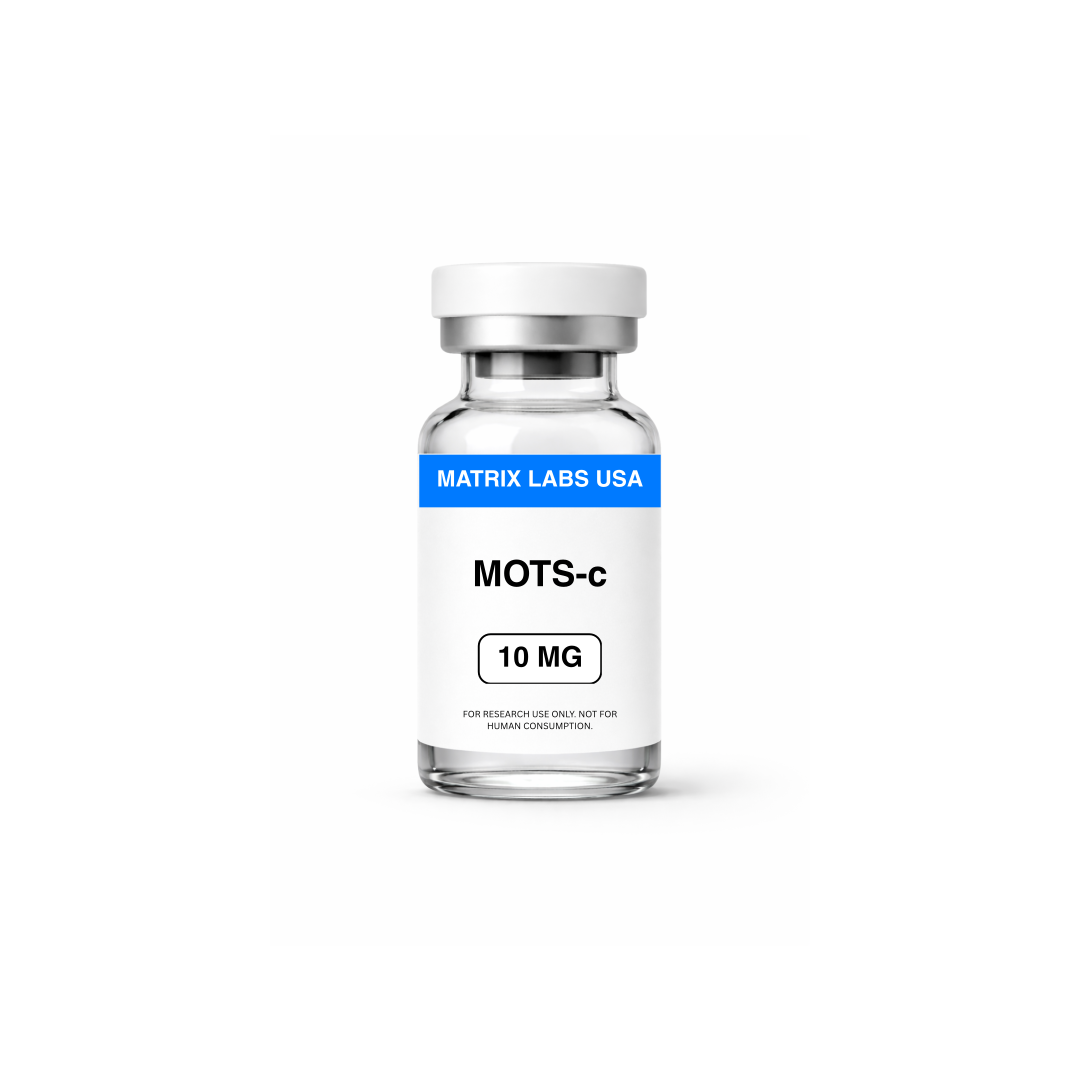
MOTS-c
$50.00
Contents: 10mg MOTS-c lyophilized peptide in sterile glass vial
Purity: ≥99% (HPLC verified by independent third-party laboratory)
Grade: Research-use only (not a drug, food, or supplement)
Form: Lyophilized powder, suitable for reconstitution with appropriate solvent
Storage (before reconstitution): Store at room temperature, protected from heat and light
Storage (after reconstitution): Store refrigerated at 2–8°C and use promptly according to your lab protocol
Note: This product is supplied as a lyophilized powder and should be reconstituted with bacteriostatic water for appropriate research handling.
Most researchers also add BAC Water 3ML to their order for convenience.
For laboratory research only. Not for human consumption, medical, or veterinary use.
MOTS-c is a short peptide encoded within the mitochondrial genome and is described in the scientific literature as part of the mitochondrial-derived peptide (MDP) class, discussed in the context of mitochondrial signaling and inter-organelle communication in experimental systems. Reports in the research literature describe MOTS-c localization in cellular compartments that can include mitochondria and, under defined laboratory stress conditions, the nucleus; these observations are limited to non-clinical cellular and animal model investigations.
Note: This product is supplied as a lyophilized powder and should be reconstituted with bacteriostatic water for appropriate research handling.
Most researchers also add BAC Water 3ML to their order for convenience.
For laboratory research only. Not for human consumption, medical, or veterinary use.
Sequence: Met-Arg-Trp-Gln-Glu-Met-Gly-Tyr-Ile-Phe-Tyr-Pro-Arg-Lys-Leu-Arg
Molecular Formula: C101H152N28O22S2
Molecular Weight: 2174.64 g/mol
PubChem SID: 255386757
CAS Number: 1627580-64-6
Reported Synonyms: Mitochondrial open reading frame of the 12S rRNA-c, MT-RNR1
In the published scientific literature, MOTS-c is referenced in non-clinical research that includes cellular assays and animal model studies, where molecular interactions, signaling components, and pathway-associated markers are measured under defined experimental conditions.
Reported research contexts include experimental work examining mitochondrial signaling-associated molecular components, nuclear translocation phenomena under laboratory stress conditions, AMPK-associated signaling elements, metabolic pathway-linked molecular markers, and gene expression patterns evaluated in cellular and animal models.
Mechanistic discussions in preclinical publications commonly frame MOTS-c within energy-sensing and stress-responsive molecular networks, including components tied to AMPK signaling.
Additional research describes dynamic nuclear localization following metabolic stress in an AMPK-dependent manner and reports interaction with stress-responsive transcriptional control frameworks, including antioxidant response element (ARE)–related regulation, within the experimental systems studied.
The original characterization of MOTS-c described a mitochondrial 12S rRNA sORF encoding a 16-amino-acid peptide and reported cellular actions linked to folate-cycle–connected metabolism and AMPK activation, alongside observations in mouse models under dietary and age-associated metabolic stress paradigms.
Subsequent Cell Metabolism work described stress-triggered nuclear translocation of MOTS-c and broad nuclear gene-expression changes under glucose restriction and related stress conditions in cell models.
Additional preclinical studies have reported MOTS-c–associated changes in signaling and metabolite profiles in diet-induced obesity models using metabolomics approaches, supporting its use as a laboratory probe for pathway mapping in metabolic-stress settings.
Lee, C., Zeng, J., Drew, B. G., et al. (2015). The mitochondrial-derived peptide MOTS-c promotes metabolic homeostasis and reduces obesity and insulin resistance. Cell Metabolism.
Kim, K. H., Son, J. M., Benayoun, B. A., & Lee, C. (2018). The Mitochondrial-Encoded Peptide MOTS-c Translocates to the Nucleus to Regulate Nuclear Gene Expression in Response to Metabolic Stress. Cell Metabolism, 28(3), 516–524.e7. https://doi.org/10.1016/j.cmet.2018.06.008
Kumagai, H., Kim, S.-J., Miller, B., et al. (2024). MOTS-c modulates skeletal muscle function by directly binding and activating CK2. iScience, 27(11), 111212. https://doi.org/10.1016/j.isci.2024.111212
Lee, C., & Cohen, P. (2016). MOTS-c: A novel mitochondrial-derived peptide regulating muscle and fat metabolism. Trends in Endocrinology & Metabolism.
Kim, S.-J., Miller, B., Mehta, H. H., et al. (2019). The mitochondrial-derived peptide MOTS-c is a regulator of plasma metabolites and enhances insulin sensitivity. Physiological Reports, 7(13), e14171. https://doi.org/10.14814/phy2.14171
Kumagai, H., Coelho, A. R., Wan, J., et al. (2021). MOTS-c reduces myostatin and muscle atrophy signaling. American Journal of Physiology – Endocrinology and Metabolism, 320, E680–E690. https://doi.org/10.1152/ajpendo.00275.2020
Mohtashami, Z., Singh, M. K., Salimiaghdam, N., Ozgul, M., & Kenney, M. C. (2022). MOTS-c, the Most Recent Mitochondrial Derived Peptide in Human Aging and Age-Related Diseases. International Journal of Molecular Sciences, 23(19), 11991. https://doi.org/10.3390/ijms231911991
To protect experimental integrity, store peptides cold, dry, and shielded from light to minimize oxidation, contamination, and degradation. For near-term use, keep unopened material refrigerated at ≤4 °C (≤39 °F) and limit time at room temperature during handling. Lyophilized (dry) peptides can tolerate short periods at room temperature, but refrigeration is preferred for best stability and longevity. For longer-term storage, keep unmixed material frozen—−18 °C (0 °F) is acceptable, while −80 °C (−112 °F) is optimal for multi-month to multi-year preservation. Avoid frost-free freezers and repeated freeze–thaw cycles, which can accelerate breakdown. If reconstituted (in solution), use sterile buffer (ideally pH 5–6 when feasible), split into aliquots, and freeze (preferably −80 °C (−112 °F)) to reduce handling-related degradation.
All Articles and product information provided on this website are for informational and educational purposes only.
Popular products
-

Semax
$50.00 Select options This product has multiple variants. The options may be chosen on the product page -
Wolverine
$100.00 Select options This product has multiple variants. The options may be chosen on the product page -
GHRP-2
$30.00 Select options This product has multiple variants. The options may be chosen on the product page -
DSIP
$60.00 Select options This product has multiple variants. The options may be chosen on the product page
Reviews
There are no reviews yet.