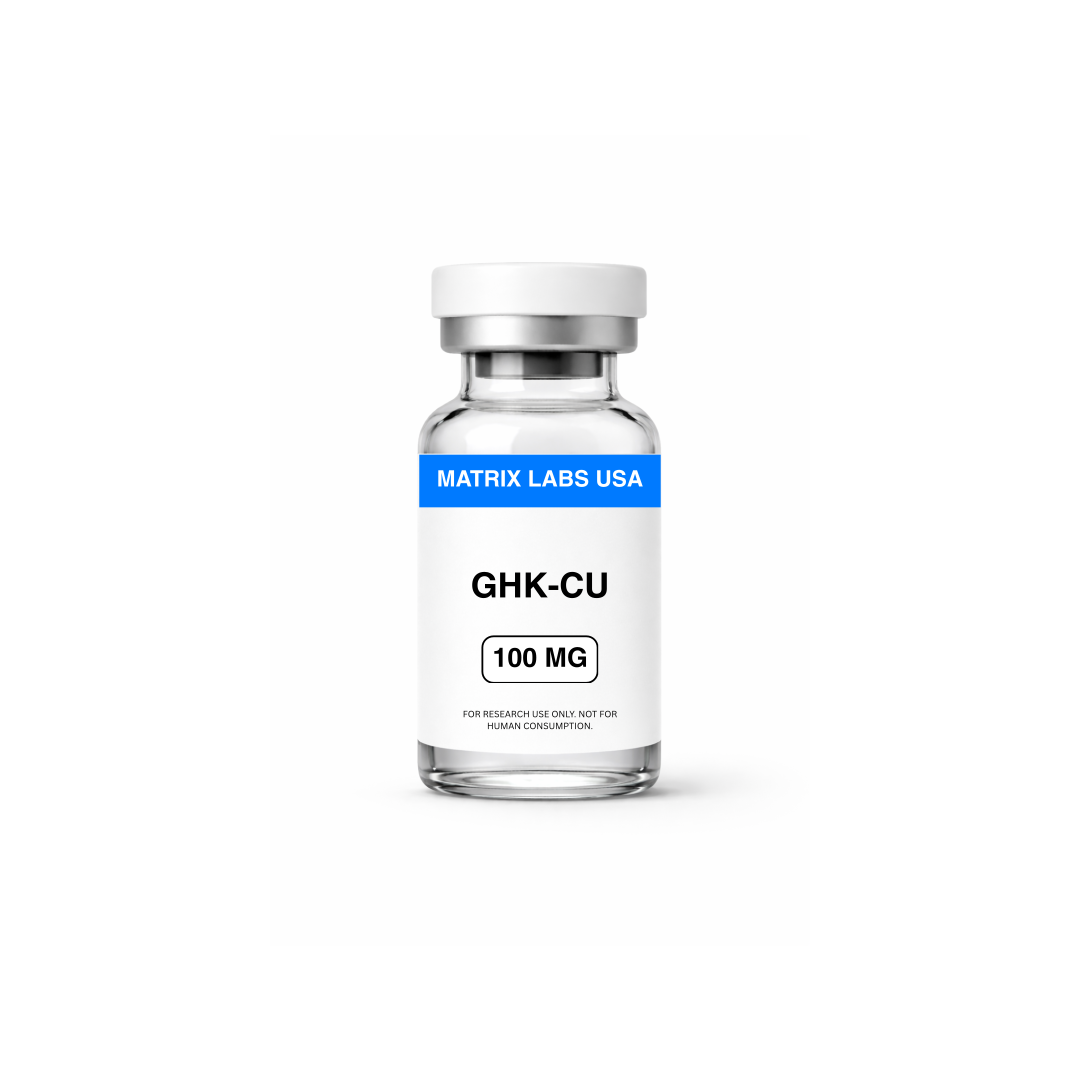
GHK-CU
$100.00
Contents: 100mg GHK-Cu lyophilized copper peptide in sterile glass vial
Purity: ≥99% (HPLC verified by independent third-party laboratory)
Grade: Research-use only (not a drug, food, or cosmetic)
Form: Lyophilized powder, suitable for reconstitution with appropriate solvent
Storage (before reconstitution): Store at room temperature, protected from heat and light
Storage (after reconstitution): Store refrigerated at 2–8°C and use promptly according to your lab protocol
Note: This product is supplied as a lyophilized powder and should be reconstituted with bacteriostatic water for appropriate research handling.
Most researchers also add BAC Water 3ML to their order for convenience.
For laboratory research only. Not for human consumption, medical, cosmetic, or veterinary use.
GHK-Cu is a copper(II)-complexed tripeptide used in laboratory research as a peptide–metal probe for dermal and extracellular-matrix (ECM) biology, with frequent use in topical-format experimental workflows where localized exposure is being modeled.
In controlled in vitro and preclinical systems, it is commonly studied for how copper coordination can influence redox homeostasis, metalloprotein activity, and transcriptional programs involved in tissue remodeling.
Note: This product is supplied as a lyophilized powder and should be reconstituted with bacteriostatic water for appropriate research handling.
Most researchers also add BAC Water 3ML to their order for convenience.
For laboratory research only. Not for human consumption, medical, cosmetic, or veterinary use.
Peptide identity: glycyl-L-histidyl-L-lysine coordinated with Cu²⁺ (often written as Gly-His-Lys·Cu²⁺).
Preparation notes: depending on manufacturing and salt form, counterions may be present; one common representation is Cu-GHK.
Molecular formula (Cu-GHK): C14H24CuN6O4.
PubChem compound entry for Cu-GHK is available for cross-referencing identifiers and structure-level information.
GHK-Cu is frequently applied in fibroblast and skin-relevant cellular models to interrogate ECM production and remodeling readouts, including collagen- and proteoglycan-associated endpoints under controlled conditions.
It is also used in studies of cell–matrix communication, where adhesion- and organization-related phenotypes are measured alongside transcriptional or protein-level markers.
Because copper participates in redox-active chemistry and copper-dependent enzymology, GHK-Cu is additionally used as a tool compound in oxidative-stress and metal-homeostasis experiments with ROS-linked endpoints.
Mechanistic framing typically emphasizes copper-dependent modulation of matrix biology, including shifts in synthesis-versus-remodeling balance that can be evaluated through collagen metrics, glycosaminoglycan/proteoglycan profiles, and related gene-expression panels.
In dermal fibroblast culture, publications have reported changes consistent with altered ECM turnover signaling, including matrix metalloproteinase-related readouts and corresponding inhibitor secretion patterns, supporting its use as a remodeling-focused probe in vitro.
Fibroblast collagen synthesis: an early report in FEBS Letters described stimulation of collagen synthesis in fibroblast cultures with the tripeptide–copper complex, providing a foundational ECM-focused rationale for subsequent model development.
Wound-chamber ECM composition: in a rat wound-chamber model and dermal fibroblast cultures, investigators reported modulation of glycosaminoglycan composition and small proteoglycan expression (including decorin and biglycan mRNA patterns) across the repair timeline.
Remodeling enzymes in culture: a Life Sciences study reported increased MMP-2 levels and MMP-2 mRNA in conditioned media from fibroblast cultures alongside increased TIMP-1 and TIMP-2 secretion, consistent with a coordinated remodeling signature under those experimental conditions.
Systems-level interpretation: a later review synthesized diverse preclinical findings and highlighted broad gene-expression modulation associated with GHK/GHK-Cu in experimental datasets, offering mechanistic hypotheses to test rather than clinical conclusions.
Maquart, F. X., et al. (1988). Stimulation of collagen synthesis in fibroblast cultures by the tripeptide-copper complex glycyl-L-histidyl-L-lysine-Cu2+. FEBS Letters, 238(2), 343–346. https://doi.org/10.1016/0014-5793(88)80509-X
Siméon, A., Wegrowski, Y., Bontemps, Y., & Maquart, F. X. (2000). Expression of glycosaminoglycans and small proteoglycans in wounds: modulation by the tripeptide-copper complex glycyl-L-histidyl-L-lysine-Cu(2+). Journal of Investigative Dermatology, 115(6), 962–968. https://doi.org/10.1046/j.1523-1747.2000.00166.x
Pickart, L., & Margolina, A. (2018). Regenerative and protective actions of the GHK-Cu peptide in the light of the new gene data. International Journal of Molecular Sciences, 19(7), 1987. https://doi.org/10.3390/ijms19071987
Siméon, A., et al. (2000). The tripeptide-copper complex glycyl-L-histidyl-L-lysine-Cu2+ stimulates matrix metalloproteinase-2 expression by fibroblast cultures. Life Sciences, 67(18), 2257–2265. https://doi.org/10.1016/S0024-3205(00)00803-1
Wegrowski, Y., et al. (1992). Stimulation of sulfated glycosaminoglycan synthesis by the glycyl-L-histidyl-L-lysine-copper(II) complex in human fibroblasts (in vitro). Life Sciences.
Cu-GHK (PubChem CID 378611). Compound record and structure-level identifiers for the copper complex. National Library of Medicine.
To protect experimental integrity, store peptides cold, dry, and shielded from light to minimize oxidation, contamination, and degradation. For near-term use, keep unopened material refrigerated at ≤4 °C (≤39 °F) and limit time at room temperature during handling. Lyophilized (dry) peptides can tolerate short periods at room temperature, but refrigeration is preferred for best stability and longevity. For longer-term storage, keep unmixed material frozen—−18 °C (0 °F) is acceptable, while −80 °C (−112 °F) is optimal for multi-month to multi-year preservation. Avoid frost-free freezers and repeated freeze–thaw cycles, which can accelerate breakdown. If reconstituted (in solution), use sterile buffer (ideally pH 5–6 when feasible), split into aliquots, and freeze (preferably −80 °C (−112 °F)) to reduce handling-related degradation.
All Articles and product information provided on this website are for informational and educational purposes only.
Popular products
-

BPC-157
$70.00 Select options This product has multiple variants. The options may be chosen on the product page -
Ipamorelin
$55.00 Select options This product has multiple variants. The options may be chosen on the product page -
CJC + Ipamorelin
$70.00 Select options This product has multiple variants. The options may be chosen on the product page -
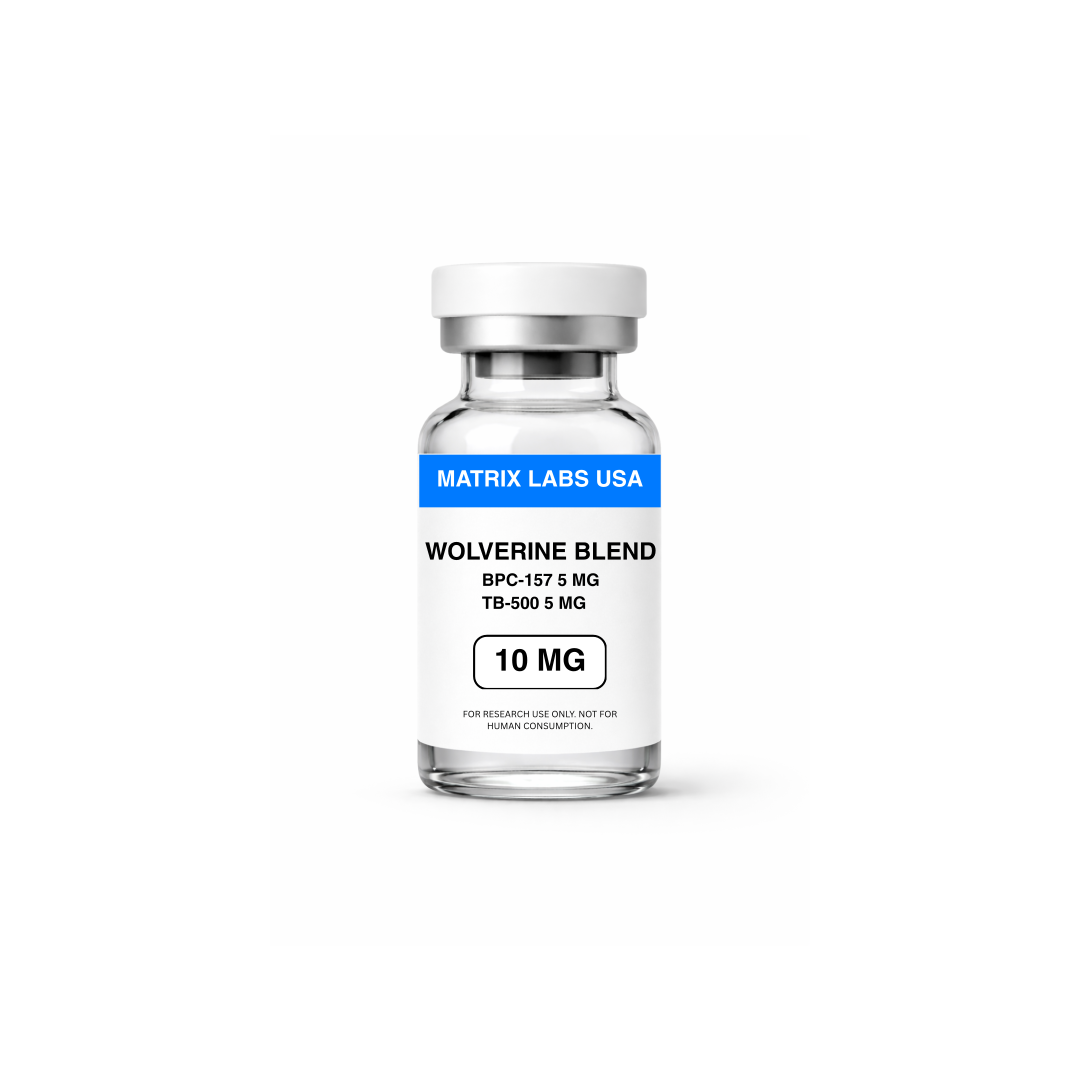
Wolverine
$100.00 Select options This product has multiple variants. The options may be chosen on the product page
Reviews
There are no reviews yet.