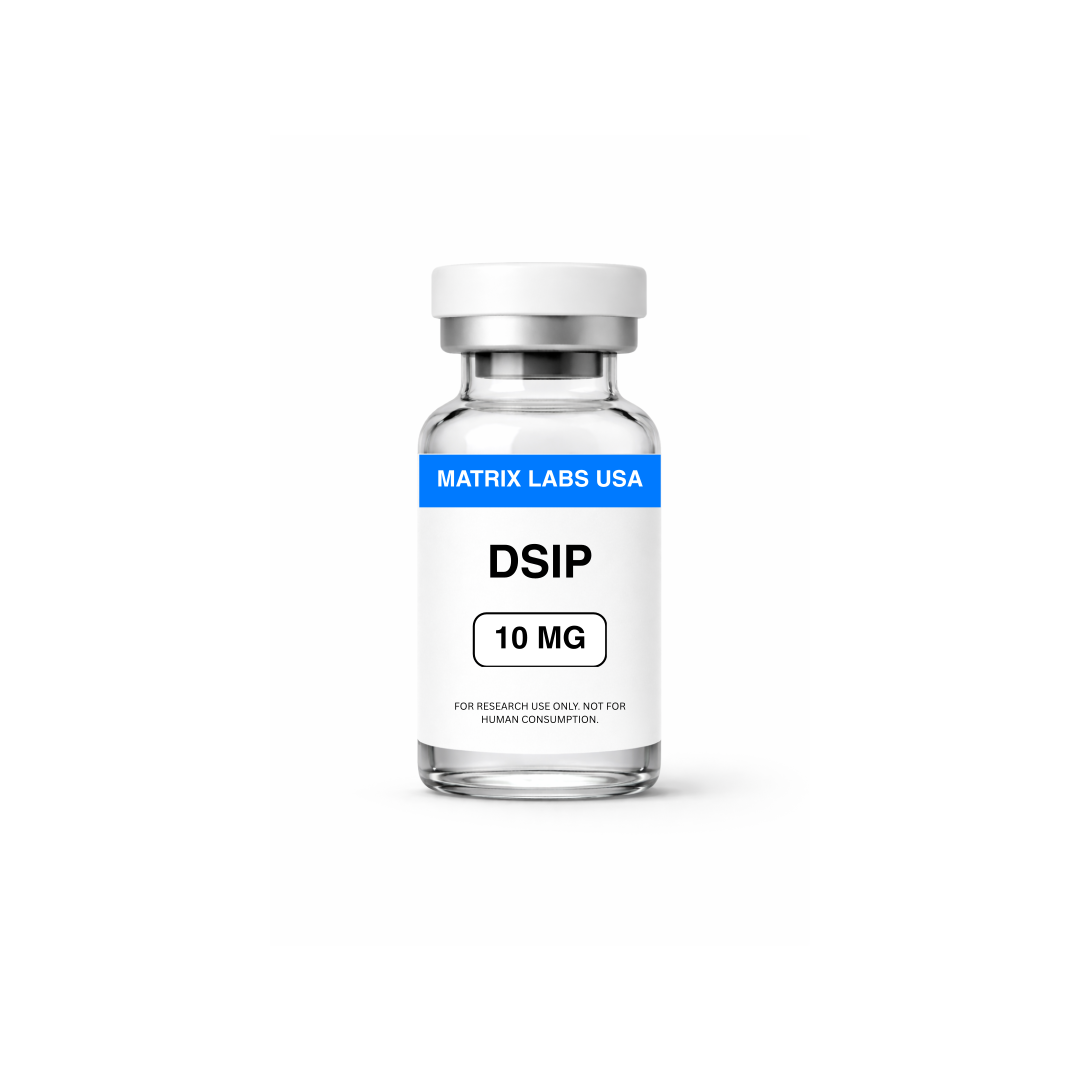
DSIP
$60.00
Delta sleep-inducing peptide, or DSIP, is a synthetic nonapeptide first isolated in the 1970s and studied for its relationship to sleep regulation, circadian biology, stress adaptation, and neuroendocrine signaling. Although its exact biological role remains debated, DSIP has been investigated in both animal and human research involving sleep behavior, stress response, pain, and neurochemical regulation.
DSIP is a nine-amino-acid peptide with the sequence Trp-Ala-Gly-Gly-Asp-Ala-Ser-Gly-Glu. It has historically been studied as a sleep-associated neuropeptide, though later work suggested its effects may extend beyond sleep alone into circadian, endocrine, and neurotransmitter-related systems. Reviews have noted that DSIP research has touched on adrenergic transmission, opioid-related signaling, cortisol modulation, and central nervous system regulation.
DSIP has been explored in research involving:
* Sleep architecture and sleep efficiency
* Circadian rhythm and stress-response models
* Pain and withdrawal-related studies
* Neuroendocrine and neurotransmitter signaling
* Behavioral and psychomotor performance researchAcross the literature, DSIP is most commonly associated with sleep-related and stress-modulation research, though the peptide’s mechanism remains incompletely resolved.
The precise mechanism of DSIP is still unresolved. Published reviews and older experimental work suggest it may influence central neurotransmitter systems, including adrenergic and opioid-related signaling, while also affecting endocrine and circadian variables such as cortisol rhythms and locomotor activity. Rather than acting like a classic sedative, DSIP has been described as potentially supporting or sustaining aspects of natural sleep function and broader neuroregulatory balance.
Preclinical and early human studies examined DSIP in normal volunteers, insomniac patients, and pain-related pilot settings. In one early controlled human study, DSIP increased daytime sleep and improved later-night sleep efficiency without behaving like a classic sedative. Other studies explored its effects in chronic insomnia and chronic pain states, while reviews summarized additional work involving stress and withdrawal-related models. The total body of evidence is mixed and heterogeneous, which is one reason DSIP remains scientifically interesting but mechanistically unresolved.
Graf, M. V., & Kastin, A. J. (1984). Delta-sleep-inducing peptide (DSIP): a review. Neuroscience & Biobehavioral Reviews, 8(1), 83–93. PMID: 6145137.
Graf, M. V. (1986). Delta-sleep-inducing peptide (DSIP): an update. Peptides, 7(6), 1165–1187. PMID: 3550726.
Kovalzon, V. M. (2006). Delta sleep-inducing peptide (DSIP): a still unresolved riddle. Journal of Neurochemistry, 97(2), 303–309. PMID: 16539679.
Schneider-Helmert, D., Gnirss, F., Monnier, M., Schenker, J., & Schoenenberger, G. A. (1981). Acute and delayed effects of DSIP (delta sleep-inducing peptide) on human sleep behavior. International Journal of Clinical Pharmacology, Therapy, and Toxicology, 19(8), 341–345. PMID: 6895513.
Monti, J. M., Jantos, H., D’Angelo, L., & Urdapilleta, E. (1987). Study of delta sleep-inducing peptide efficacy in improving sleep disturbances in chronic insomniac patients. Sleep, 10(5), 429–435. PMID: 3583493.
Larbig, W., Gerber, W. D., Kluck, M., & Schoenenberger, G. A. (1984). Therapeutic effects of delta-sleep-inducing peptide (DSIP) in patients with chronic, pronounced pain episodes. A clinical pilot study. European Neurology, 23(5), 372–385. PMID: 6548970.
To protect experimental integrity, store peptides cold, dry, and shielded from light to minimize oxidation, contamination, and degradation. For near-term use, keep unopened material refrigerated at ≤4 °C (≤39 °F) and limit time at room temperature during handling. Lyophilized (dry) peptides can tolerate short periods at room temperature, but refrigeration is preferred for best stability and longevity. For longer-term storage, keep unmixed material frozen—−18 °C (0 °F) is acceptable, while −80 °C (−112 °F) is optimal for multi-month to multi-year preservation. Avoid frost-free freezers and repeated freeze–thaw cycles, which can accelerate breakdown. If reconstituted (in solution), use sterile buffer (ideally pH 5–6 when feasible), split into aliquots, and freeze (preferably −80 °C (−112 °F)) to reduce handling-related degradation.
All Articles and product information provided on this website are for informational and educational purposes only.
Popular products
-

Wolverine
Original price was: $100.00.$85.00Current price is: $85.00. Select options This product has multiple variants. The options may be chosen on the product page -
BPC-157
Original price was: $70.00.$65.00Current price is: $65.00. Select options This product has multiple variants. The options may be chosen on the product page -
GHRP-2
$30.00 Select options This product has multiple variants. The options may be chosen on the product page -
MT II
$50.00 Select options This product has multiple variants. The options may be chosen on the product page
Reviews
There are no reviews yet.