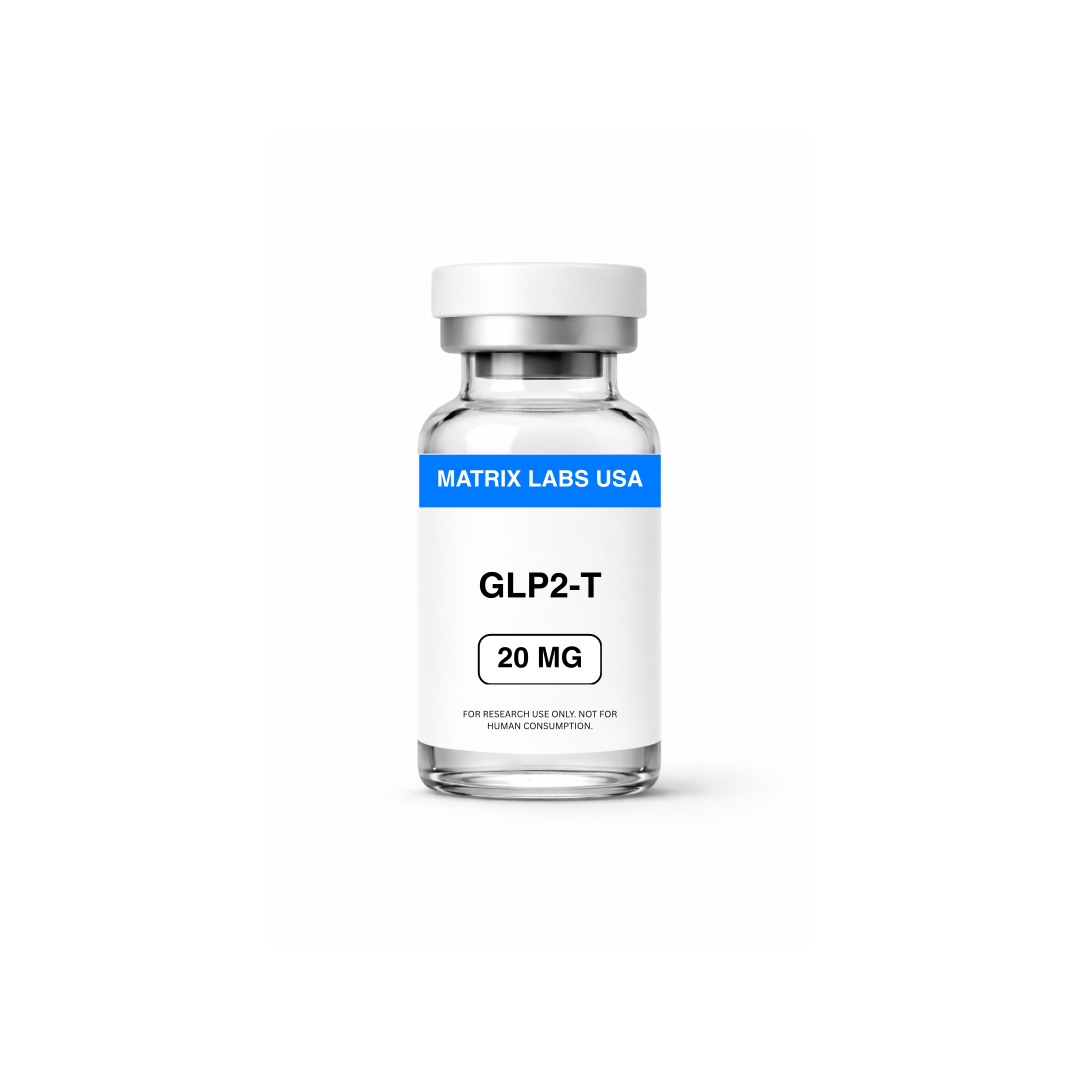
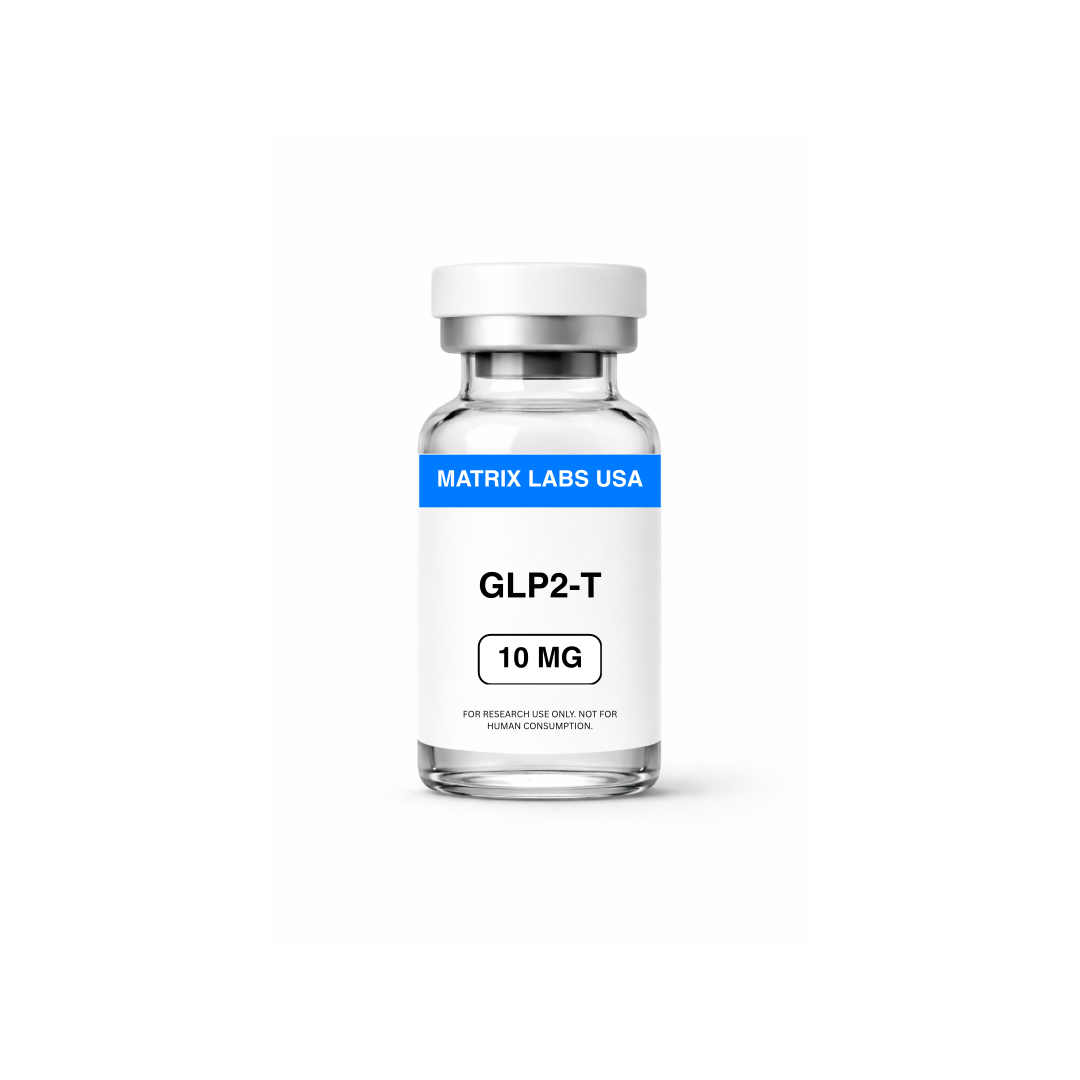

GLP2-T
Price range: $180.00 through $280.00
Contents: GLP2-T lyophilized peptide in sterile glass vial
Available strengths: 10mg and 20mg (select desired strength before checkout)
Purity: ≥99% (HPLC verified by independent third-party laboratory)
Grade: Research-use only (not a drug, food, or supplement)
Form: Lyophilized powder, suitable for reconstitution with appropriate solvent
Storage (before reconstitution): Store at room temperature, protected from heat and light
Storage (after reconstitution): Store refrigerated at 2–8°C and use promptly according to your lab protocol
Note: This product is supplied as a lyophilized powder and should be reconstituted with bacteriostatic water for appropriate research handling.
Most researchers also add BAC Water 3ML to their order for convenience.
For laboratory research only. Not for human consumption, medical, cosmetic, or veterinary use.
GLP2-T is a long-acting, acylated peptide used in research as a dual incretin-receptor agonist input that engages both the glucose-dependent insulinotropic polypeptide receptor (GIPR) and the glucagon-like peptide-1 receptor (GLP-1R).
In laboratory systems, GLP2-T is commonly used to compare dual-agonist pharmacology versus single-receptor GLP-1R agonists, with emphasis on receptor potency, signaling kinetics, and downstream pathway output under controlled conditions.
Note: This product is supplied as a lyophilized powder and should be reconstituted with bacteriostatic water for appropriate research handling.
Most researchers also add BAC Water 3ML to their order for convenience.
For laboratory research only. Not for human consumption, medical, cosmetic, or veterinary use.
GLP2-T is described as a 39–amino acid linear peptide conjugated to a C20 fatty diacid via a linker attached to a lysine residue (commonly referenced as Lys20) to enable strong albumin association and prolonged exposure.
Structural studies describe non-coded amino-acid substitutions (including α-aminoisobutyric acid, Aib) and acylation architecture (linker plus fatty diacid) as key determinants of stability, receptor engagement, and duration.
Molecular formula:
C225H348N48O68.Molecular weight (computed, GLP2-T): ~4813 g/mol.
PubChem compound record: CID 156588324.
GLP2-T is used in receptor pharmacology workflows to quantify integrated agonism across GIPR and GLP-1R, including cAMP-linked signaling assays, receptor occupancy or binding designs, and comparative efficacy studies across incretin ligands.
It is also used in signaling-profiling research to examine “biased” or imbalanced signaling behavior, particularly where GLP-1R responses are separated into second-messenger output versus β-arrestin recruitment and trafficking-linked endpoints.
In systems biology and structural pharmacology, GLP2-T is used as a tool ligand for receptor-structure mapping (including cryo-EM studies of ligand–receptor–Gs complexes) to relate sequence and acylation features to receptor engagement and downstream activation.
In preclinical energy-balance research, GLP2-T is used to probe intake regulation and food-choice behaviors under controlled diet paradigms and receptor-control models.
GLP2-T is annotated as a dual agonist at GIPR and GLP-1R, both of which are class B GPCRs that commonly couple to Gs and promote cAMP signaling in many cellular contexts.
A recurring mechanistic framing is that GLP2-T shows stronger functional engagement at GIPR relative to GLP-1R while exhibiting GLP-1R signaling properties that can be biased toward cAMP generation compared with β-arrestin recruitment, depending on the assay system.
Exposure protraction is explained in regulatory labeling as a consequence of the C20 fatty diacid side chain that enables albumin binding, with metabolism described as proteolytic cleavage of the peptide backbone plus β-oxidation of the fatty diacid and amide hydrolysis.
Discovery-to-proof-of-concept work describes GLP2-T (LY3298176) as activating both GIPR and GLP-1R signaling in vitro and producing glucose-dependent metabolic effects in animal models, alongside reductions in food intake and body weight in chronic mouse studies relative to selective GLP-1R agonist comparators.
Mechanistic feeding studies report that GLP2-T suppresses caloric intake and can shift food-choice behavior in rodent models, with loss of the food-preference effect in GLP-1R knockout mice supporting a GLP-1R-dependent component for that specific behavioral phenotype.
Structural biology studies provide cryo-EM snapshots of GLP2-T bound to GIPR and GLP-1R in complex with Gs, supporting hypothesis-driven mapping of how the peptide backbone and lipidation geometry enable multiplexed receptor engagement.
Labeling summaries report an elimination half-life on the order of ~5–6 days in studied populations, which is consistent with use as a long-duration agonist input in experimental designs where sustained incretin-receptor activation is required.
Coskun T, Sloop KW, Loghin C, et al. LY3298176, a novel dual GIP and GLP-1 receptor agonist for the treatment of type 2 diabetes mellitus: From discovery to clinical proof of concept. Molecular Metabolism. 2018;18:3–14. doi:10.1016/j.molmet.2018.09.009
Willard FS, Douros JD, Gabe MB, et al. Tirzepatide is an imbalanced and biased dual GIP and GLP-1 receptor agonist. JCI Insight. 2020.
U.S. Food and Drug Administration. (tirzepatide) injection prescribing information. 2025.
Geisler CE, Hepler C, Higgins MR, et al. Tirzepatide suppresses palatable food intake in rodents. 2022.
Sun B, et al. Structural determinants of dual incretin receptor agonism for tirzepatide. Proceedings of the National Academy of Sciences. 2022.
Zhao F, et al. Structural insights into multiplexed pharmacological actions of multi-targeting peptides including tirzepatide. Nature Communications. 2022.
IUPHAR/BPS Guide to Pharmacology. Tirzepatide ligand annotation page (includes structural and receptor-target notes).
PubChem. Tirzepatide compound record (CID 156588324).
To protect experimental integrity, store peptides cold, dry, and shielded from light to minimize oxidation, contamination, and degradation. For near-term use, keep unopened material refrigerated at ≤4 °C (≤39 °F) and limit time at room temperature during handling. Lyophilized (dry) peptides can tolerate short periods at room temperature, but refrigeration is preferred for best stability and longevity. For longer-term storage, keep unmixed material frozen—−18 °C (0 °F) is acceptable, while −80 °C (−112 °F) is optimal for multi-month to multi-year preservation. Avoid frost-free freezers and repeated freeze–thaw cycles, which can accelerate breakdown. If reconstituted (in solution), use sterile buffer (ideally pH 5–6 when feasible), split into aliquots, and freeze (preferably −80 °C (−112 °F)) to reduce handling-related degradation.
All Articles and product information provided on this website are for informational and educational purposes only.
Popular products
-

GLP1-S
$180.00 Select options This product has multiple variants. The options may be chosen on the product page -
GLP3-R
Price range: $100.00 through $280.00 Select options This product has multiple variants. The options may be chosen on the product page
Reviews
There are no reviews yet.