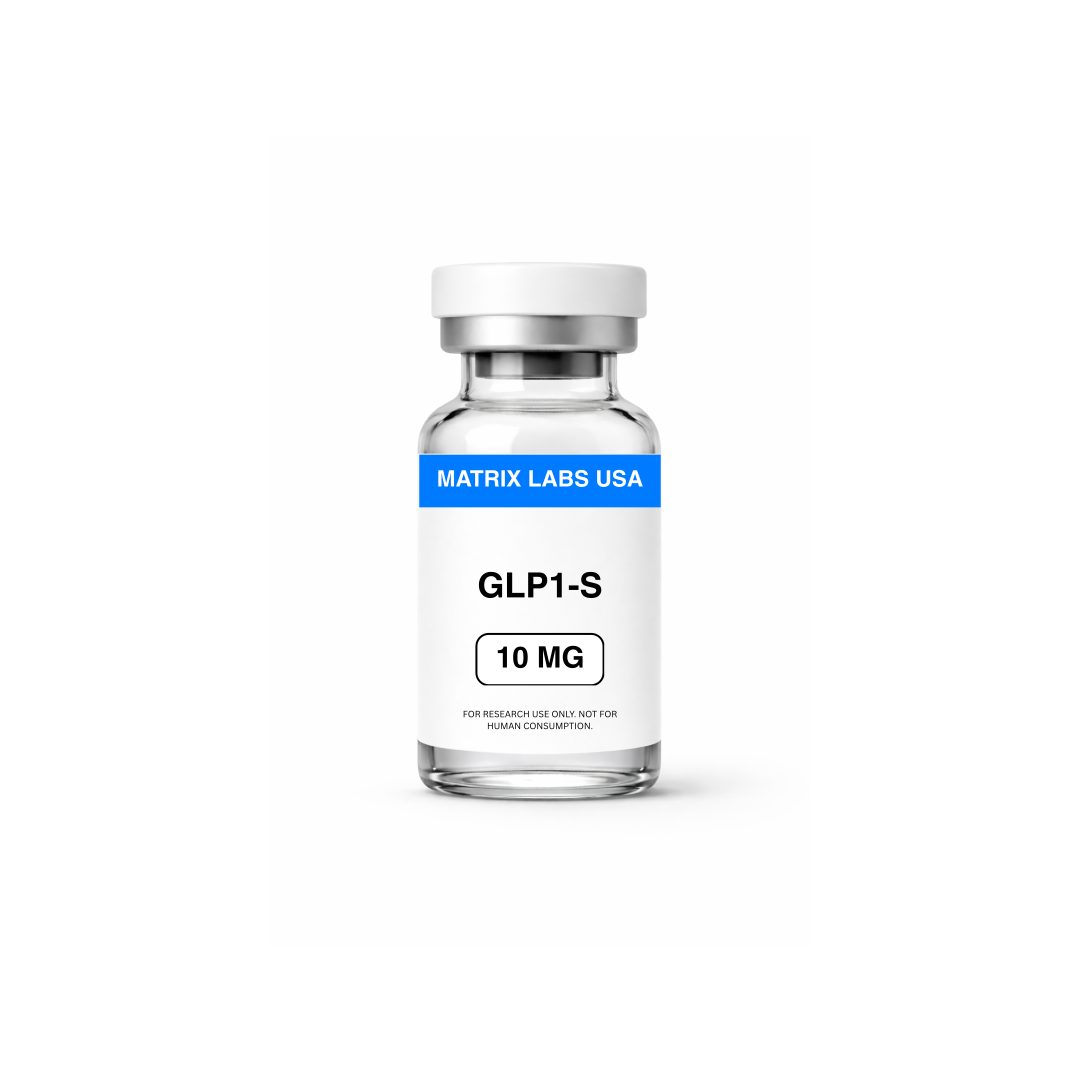
GLP1-S
$180.00
Contents: 10mg GLP1-S lyophilized peptide in sterile glass vial
Purity: ≥99% (HPLC verified by independent third-party laboratory)
Grade: Research-use only (not a drug, food, or supplement)
Form: Lyophilized powder, suitable for reconstitution with appropriate solvent
Storage (before reconstitution): Store at room temperature, protected from heat and light
Storage (after reconstitution): Store refrigerated at 2–8°C and use promptly according to your lab protocol
Note: This product is supplied as a lyophilized powder and should be reconstituted with bacteriostatic water for appropriate research handling.
Most researchers also add BAC Water 3ML to their order for convenience.
For laboratory research only. Not for human consumption, medical, cosmetic, or veterinary use.
GLP1-S is a long-acting, modified GLP-1 analogue used in laboratory research as a defined GLP-1 receptor agonist input for incretin-pathway pharmacology and downstream signaling studies. GLP1-S selectively binds to and activates the GLP-1 receptor, enabling controlled interrogation of GLP-1R-driven cellular responses in engineered systems and preclinical models.
Note: This product is supplied as a lyophilized powder and should be reconstituted with bacteriostatic water for appropriate research handling.
Most researchers also add BAC Water 3ML to their order for convenience.
For laboratory research only. Not for human consumption, medical, cosmetic, or veterinary use.
GLP1-S is a GLP-1 analogue reported to have 94% sequence homology to human GLP-1.
Key structural features used to protract exposure include albumin binding enabled by acylation of the lysine at position 26 with a hydrophilic spacer and a C18 fatty di-acid, along with additional peptide modifications intended to improve stability and manufacturability.
Regulatory descriptions note stabilization against DPP-4 degradation via a position 8 modification and a position 34 change to support selective single-chain acylation.
Molecular formula: C187H291N45O59
Molecular weight: approximately 4113.6 g/mol
PubChem compound record: GLP1-S (CID 56843331)
GLP1-S is commonly used in GLP-1R pharmacology workflows to quantify receptor potency and efficacy using cAMP-linked readouts, receptor internalization/desensitization assays, and pathway mapping designs that compare GLP-1R agonists under standardized conditions.
In translational preclinical paradigms, GLP1-S is frequently used to probe central versus peripheral GLP-1R contributions to feeding-related behavior and metabolic endpoints, with study designs that isolate GLP-1R dependence using anatomical targeting and receptor-based controls.
GLP1-S is also used as a benchmark comparator in research evaluating long-acting GLP-1R agonist design principles, including how albumin affinity and protease resistance influence exposure profiles and functional outputs.
GLP1-S acts as a GLP-1 receptor agonist that selectively binds to and activates GLP-1R, a class B GPCR that canonically couples to Gs and increases intracellular cAMP in many cellular contexts.
Mechanistic protraction is primarily attributed to strong albumin binding, which reduces renal clearance and provides protection from metabolic degradation; GLP1-S-related material is eliminated mainly through proteolytic cleavage of the peptide backbone and sequential beta-oxidation of the fatty-acid side chain.
Because GLP-1R signaling can be context-dependent and may include receptor trafficking and arrestin-related components, research designs often include multiple orthogonal readouts (second messenger, internalization, transcriptional markers) to distinguish efficacy from signaling bias or receptor regulation effects.
Discovery and optimization work describing GLP1-S’s design emphasizes increasing albumin affinity and improving stability against metabolic degradation while maintaining GLP-1R potency, providing a foundation for once-weekly pharmacology investigations.
In rodent mechanistic studies, GLP1-S has been used to map appetite- and weight-related effects to distributed GLP-1 receptor populations in the brain, with findings supporting GLP-1R-dependent modulation of feeding behavior and food preference under controlled experimental conditions.
Regulatory pharmacology summaries describe GLP1-S’s long apparent half-life and high albumin binding, which together enable prolonged systemic exposure and make it a useful tool compound when long-duration GLP-1R activation is required for experimental designs.
Lau, J., Bloch, P., Schaffer, L., et al. (2015). Discovery of the once-weekly glucagon-like peptide-1 (GLP-1) analogue semaglutide. Journal of Medicinal Chemistry.
U.S. Food and Drug Administration. (2025). semaglutide injection prescribing information.
Gabery, S., Salinas, C. G., Paulsen, S. J., et al. (2020). Semaglutide lowers body weight in rodents via distributed neural pathways. eLife.
European Medicines Agency. (2025). EPAR product information (semaglutide).
Knudsen, L. B., & Lau, J. (2019). The discovery and development of liraglutide and semaglutide. Frontiers in Endocrinology.
IUPHAR/BPS Guide to Pharmacology. GLP-1 receptor target page and semaglutide ligand annotations.
PubChem. Semaglutide compound record (CID 56843331).
To protect experimental integrity, store peptides cold, dry, and shielded from light to minimize oxidation, contamination, and degradation. For near-term use, keep unopened material refrigerated at ≤4 °C (≤39 °F) and limit time at room temperature during handling. Lyophilized (dry) peptides can tolerate short periods at room temperature, but refrigeration is preferred for best stability and longevity. For longer-term storage, keep unmixed material frozen—−18 °C (0 °F) is acceptable, while −80 °C (−112 °F) is optimal for multi-month to multi-year preservation. Avoid frost-free freezers and repeated freeze–thaw cycles, which can accelerate breakdown. If reconstituted (in solution), use sterile buffer (ideally pH 5–6 when feasible), split into aliquots, and freeze (preferably −80 °C (−112 °F)) to reduce handling-related degradation.
All Articles and product information provided on this website are for informational and educational purposes only.
Popular products
-

GLP2-T
Price range: $180.00 through $280.00 Select options This product has multiple variants. The options may be chosen on the product page -
GLP3-R
Price range: $100.00 through $280.00 Select options This product has multiple variants. The options may be chosen on the product page
Reviews
There are no reviews yet.